
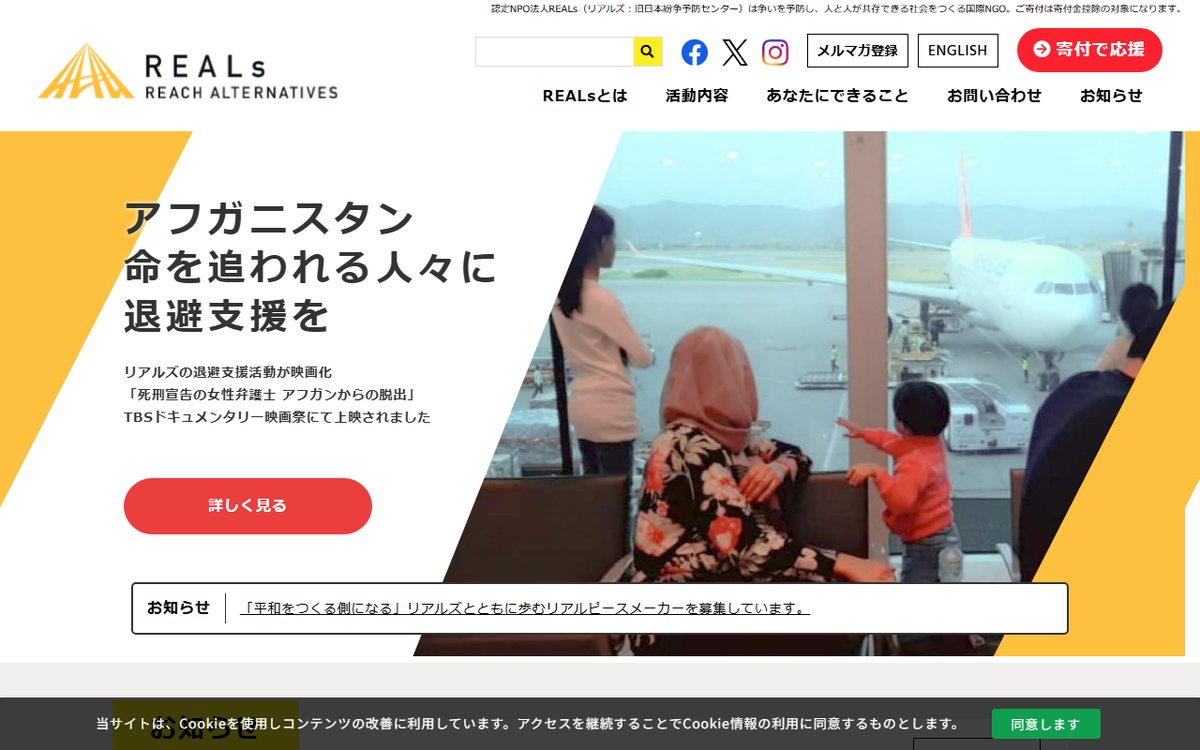
Reach Alternatives (REALs) is an international NGO that works to prevent conflict and create societies where people can coexist. Formerly called the Japan Center for Conflict Prevention, it carries the message "More options for preventing conflict." It works as a conflict prevention specialist in Asia, Africa and the Middle East, as well as in Japan.
It was founded in July 1999, obtained NPO corporation status in February 2002 and certified NPO status in July 2010. Its work is organized into five areas of expertise: conflict prevention, coexistence, gender, psychosocial care and emergency aid. Its priority issues include building a society that makes children neither victims nor perpetrators, helping women become agents of peace rather than victims, and fostering a "capacity for coexistence" that does not turn differences into division.
It currently works in Myanmar, Palestine and Gaza, Afghanistan, Syria, Turkey, South Sudan, Kenya, Somalia and Japan. Recent activity reports introduce efforts such as creating safe spaces for children in Gaza, distributing food and daily necessities in Myanmar, and building dialogue and trust in Syria.
Key points
- Five areas of expertise: conflict prevention, coexistence, gender, psychosocial care and emergency aid
- Active in nine countries and regions across Asia, Africa, the Middle East and Japan
- Many ways to take part, including donations, pro bono work and volunteering
Why this organization deserves attention
A distinguishing feature is that it looks beyond responding after conflict breaks out, to preventing conflict in the first place and to psychosocial care for both victims and perpetrators. Its broad, expertise-based approach is reflected even in its name.
Under the call to "become someone who builds peace," it offers paths for citizens to take part, such as monthly donations, pro bono work, volunteering and internships. It is also worth noting that it works on issues within Japan.
Editor's comment
Peace can sound like a distant topic, but the ability to accept differences and live together is connected to our everyday lives. REALs' phrase "capacity for coexistence" seems to hold a hint of how.
The official website offers reports by country and information on its email newsletter. Why not start with a country or field that interests you?